Istor · a private research notebook that runs entirely on your machine
It shows you what it saw.
Local. Offline. Every claim points at its passage.
Follow the build See the evidenceTell me about the cycles.
Thoughts
The Antikythera mechanism incorporated several key astronomical cycles:
The Metonic cycle is an astronomical period of 19 tropical years, almost exactly equal to 235 synodic lunar months or 6,940 days1, source 1.
The mechanism’s gearing incorporated a pin-and-slot mechanism that matches Hipparchus’s lunar theory, replicating the Moon’s variable velocity4, source 4, Decoding Antikythera mechanism.
Who made it?
Thoughts
Your library does not settle that. The ten sources describe the gearing, the dials and the inscriptions in close detail; none of them identifies a maker, and the names they raise are offered as possibilities rather than findings.
Want more on this from the web?
- Yes, search the web
- Change the search query
- Add website links directly
- No thanks
What do the inscriptions say?
Thoughts
The inscriptions are the mechanism’s own manual, cut into the plates rather than printed beside them. The back cover says what each dial does, and the dials label themselves: month names from several Greek calendars ring the Metonic spiral, and the Saros dial is lettered with the eclipses it predicts, down to the hour and the direction of the shadowDecoding Antikythera mechanism“eclipse predictions given to the hour, with the direction of the shadow”.
Most of that text came off the fragments rather than their surface. The surviving lettering is small and partly corroded, and the imaging work is what recovered it. Read together the plates say the machine was meant to be read: the front dial shows where the sun and moon are, and the back is where the mechanism explains itself.
It checks what you already gave it.
Before it looks anywhere else. If the documents in your library already settle the question, Istor answers from them and never goes online: the tool works unplugged, and stays quiet when you ask it to.
The decision is the small model’s. Istor runs two, and the cheap question goes first (is this already answered here?), so the better model can be slow, and can be right.
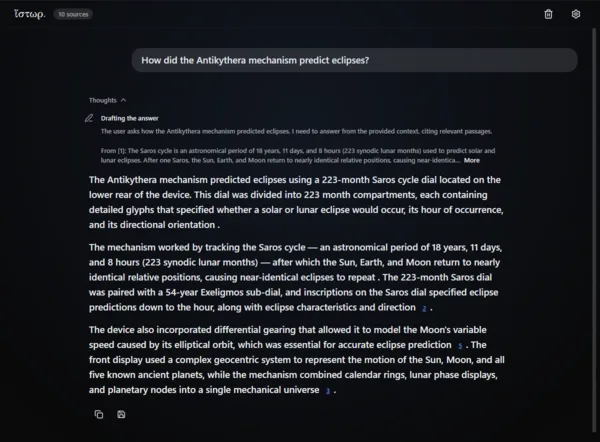
Every claim points at a passage.
Every citation resolves to a passage in a source you own or a page it actually fetched. Two failures go away: it will not invent a fact, and it will not tell you something does not exist because it falls outside a training cutoff.
Sometimes the model writes a good answer and forgets to cite as it goes. Istor sends the small model to fit a citation quickly, and marks what it fitted: Unverified, check the source.
That word is not a guess about truth. It names the model that put the number there, and it tells you to go and look.
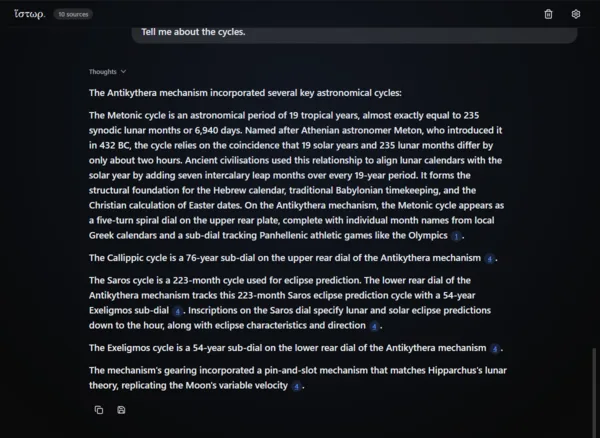
You can watch it decide.
Open the disclosure above any answer and read what it did: the reasoning, then the passages it pulled, each with its source. It is the evidence the answer rests on, in the product’s own words.
When the gate sends it to the web, you watch that too, domain by domain, as it fetches each page and reads it.
Thoughts
-
Read en.wikipedia.org, Antikythera Mechanism
Overview
The Antikythera mechanism is an ancient Greek…
discovered in 1901. It is the oldest known example… -
Read en.wikipedia.org, Antikythera Wreck
Discovery
Around Easter 1900, Captain Dimitrios Kondos… -
Read nature.com
Nature.com
A required part of this site couldn’t load. -
Read arxiv.org, 2403
arXiv:2403.00040, An Improved Calendar Ring…
Authors
Graham Woan
Joseph Bayley
It marks what nobody knows yet.
Ask it something genuinely unsettled and it will not tidy it up. Scholars have argued over the calendar ring’s hole count for a century; the app answers with the dispute intact, row by row, rather than picking the likelier figure and moving on.
It is the same discipline as the citation mark, pointed at a different gap. One says here is which model put this number here. The other says here is what nobody knows yet.
- It tracks the Metonic cycle (19 solar years, about 235 lunar months)
- It incorporates the Egyptian calendar alongside the Greek zodiac
Historical attribution:
Associated with either Archimedes or Hipparchus
What Is Still Disputed
| Issue | Status |
|---|---|
| Exact date of construction | Only a range (150-100 BC) is known |
| Exact number of gears | “At least 30”: the exact count is uncertain |
| Exact number of holes in the calendar ring | 354 or 355 (354 is far more probable than 360) |
| Identity of the inventor | Archimedes or Hipparchus, both candidates |
| Whether it qualifies as a “computer” | The term is debated |
| Whether it qualifies as a “calculator” | The term is debated |
| Whether it qualifies as a “clock” | The term is debated |
| Whether it qualifies as a “calendar” | The term is debated |
| Whether it qualifies as a “planetary calculator” | The term is debated |
| Whether it qualifies as a “solar calendar” | The term is debated |
| Whether it qualifies as a “lunar calendar” | The term is debated |
| Whether it qualifies as a “solar-lunar calendar” | The term is debated |
The device is widely regarded as a technological marvel, but the precise classification and attribution remain subjects of scholarly debate.
On your machine.
Nothing leaves, and what you write stays yours. Those are two consequences of the section above rather than two separate promises, and both are settings you can open and read.
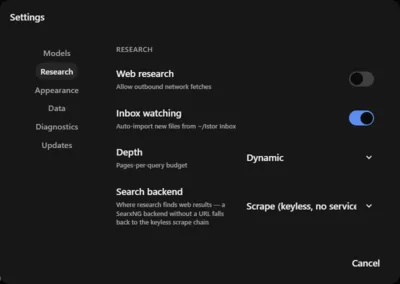
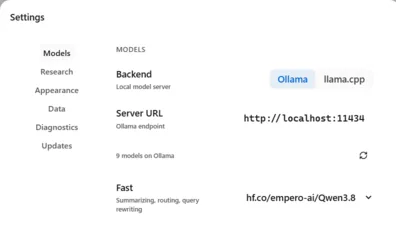
Web research is off until you turn it on, and there is no account and no key to enter. The model is one you install and point at. Istor does not ship with one. Both panels are the app, unaltered, at the size it draws them.
The library is the interface.
Sources on the left, notes on the right, the answer in the middle. Everything Istor knows is a document you put there, and everything it says can be traced back to one.
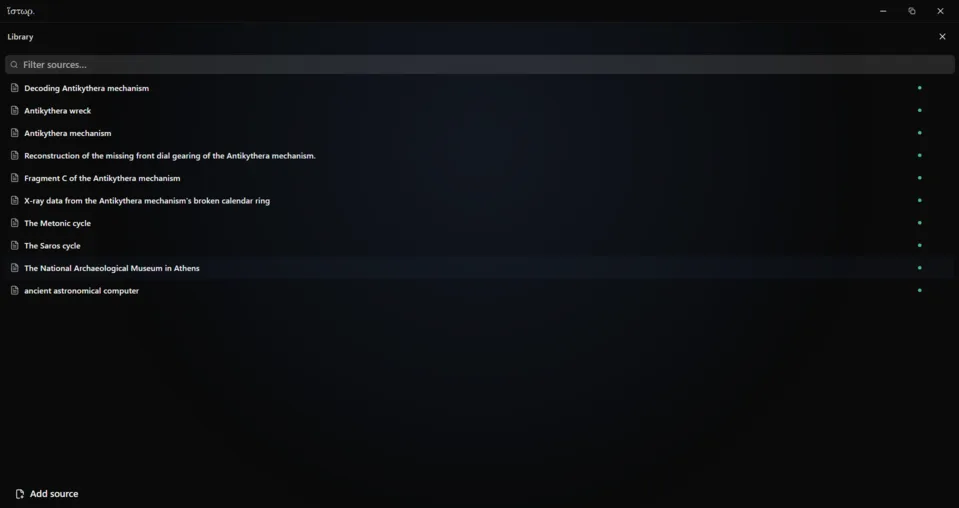
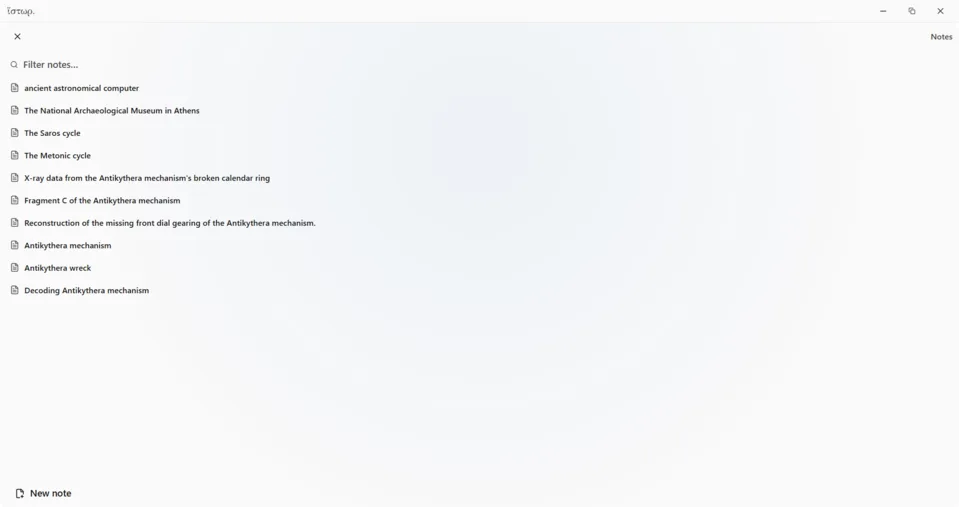
Where it stops.
Where it refuses. It does not guess. If your sources do not cover your question, it says so. The refusal is deliberate.
Where it genuinely ends. It is not a frontier model and it will not out-reason one. It needs sources, and local means your machine is part of the deal.
What it did, and how well.
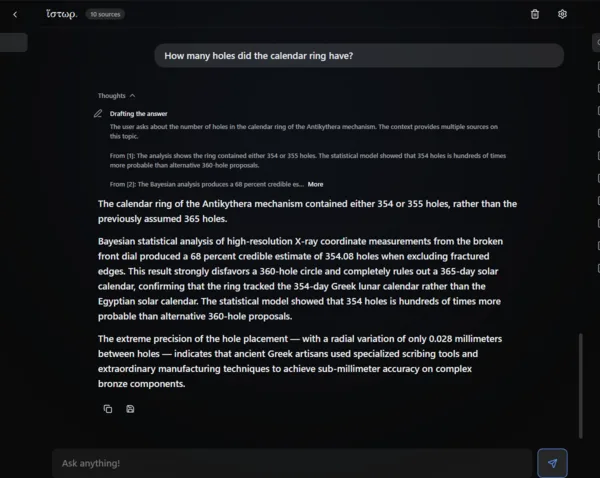
Ask it something measurable and it reports the measurement, including the part that is wrong. These are the figures from one question about the calendar ring.
- 354.08
- holes in the calendar ring, as fitted from the X-ray data, not a whole number, because the ring is not one.
- 68%
- how much confidence the app attaches to that count. It prints the figure it reached, and 68 percent is not certainty.
- 0.028 mm
- how far the holes wander from a perfect circle, measured on a ring that was cut by hand.
- 4
- citations in the answer at the top of this page. Every claim in it resolves to a passage in one of ten documents.
Questions
Does anything leave my computer?
No. The model and the search run on your machine, and so does the reading. Web research is off until you turn it on in Settings, and when you do turn it on there is no account and no key to enter.
What hardware do I need?
It depends on the model you choose, which is why we do not print a number. A small model runs on a modest graphics card; a larger one wants more. Because the requirement follows the model, there is no single floor we could publish that would be true for everyone, so we would rather say that than pick one and be wrong for half the people reading it.
Which models can it use?
A small model running on your own graphics card, and you choose which. Istor needs Ollama or llama.cpp installed; if it finds Ollama it will suggest a model, and you can run any other one instead.
Does it work with no internet at all?
Yes, and that is the case it is built for. If the documents in your library already settle your question, Istor answers from them and never goes online. With no connection at all, the library still works in full.
Is it open source?
Not yet. The repository is public and empty. It is where the code lands, and it has not landed. What we can tell you today is what is on this page: the app is local and makes no outbound requests unless you switch web research on. Every claim it makes is traceable to a document you gave it. When there is code to read, this page will say so.
When does it come out?
Windows first, with Linux and macOS after. There is no date we are ready to put on it. The installer is the next thing.
Who builds it?
Thoria builds Istor. You can find them at thoria.fyi.
ἵστωρ
It is the old Greek word for a witness, and it comes from a root that meant to see. The same root reached English, and the plate below shows how far it travelled.
A witness is someone who was there and can say what they saw, rather than the person who knows most.
That is the whole design of this tool. It does not know about the Antikythera mechanism. It read ten documents about it, and it can show you which one said what.
ἵστωρ.
Tell me about the cycles.
Thoughts
The Antikythera mechanism incorporated several key astronomical cycles, the first of which is the Metonic cycle, nineteen tropical years, almost exactly 235 lunar months1, source 1.
Istor is not finished.
There is no installer yet, and the repository is public and empty. What exists today is the app on this page, running on Windows.
Follow the buildThere are seventy-five other pages about local AI on this site. These are the ones to start with, or see all seventy-five.
Running it yourself
Answers you can check
Icons from Lucide, ISC